You can pick the most beautiful brick pavers on the market, hire the best pattern designer, and choose colors that perfectly complement your home. But if the base underneath isn’t built right, your entire investment will be compromised within a few years. It’s that simple.
After more than 16 years of installing and restoring pavers across New Port Richey and Pasco County, we’ve seen it all. We’ve torn out countless “budget-friendly” installations where contractors cut corners on the base, leaving homeowners with sunken driveways, shifted patios, and cracked walkways. The truth is, what you can’t see matters far more than what you can.
Why Most Paver Failures Start Below the Surface
When pavers fail, most people assume the pavers themselves were defective or poorly made. That’s rarely the case. The actual culprit is almost always what’s underneath—the foundation that nobody bothers to photograph or show off on social media.
Think of brick paver installation like building a house. You wouldn’t construct a beautiful home on a weak foundation and expect it to stand for decades. The same principle applies to hardscaping. The pavers you walk on are only as stable as the layers supporting them from below.
Properly installed pavers can actually outlast poured concrete and handle significantly more weight than asphalt. But here’s the catch: that durability only exists when the base is engineered correctly. Skip or skimp on base preparation, and even premium pavers will sink, separate, and require expensive repairs within a few years.
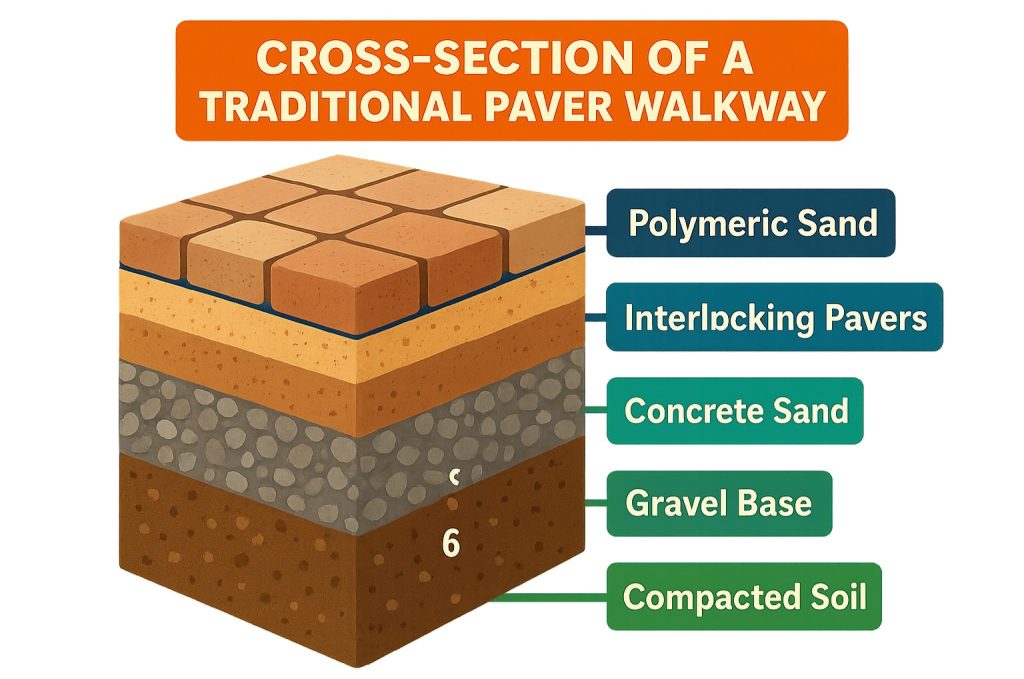
The Three Critical Layers of a Proper Paver Base
A professional brick paver installation consists of three distinct layers beneath the visible pavers. Each one serves a specific purpose, and cutting corners on any single layer jeopardizes the entire project.
Layer 1: The Subgrade (Your Foundation’s Foundation)
The subgrade is the natural soil at the bottom of your excavation. In Florida, particularly around New Port Richey and Pasco County, we typically encounter sandy soil, which actually works in our favor for drainage. However, some areas have clay-heavy soil or fill dirt from new construction, which requires special attention.
Before anything else gets added, this subgrade must be properly compacted. You can’t just dig a hole and start piling gravel in—that’s a recipe for future settling. The subgrade needs to be firm, level (or properly sloped for drainage), and free of organic material that will decompose and create voids.
For areas with clay soil or poor drainage, a geotextile fabric should be installed over the compacted subgrade. This fabric acts as a separator, preventing the subgrade from mixing with the gravel base above it. Without this barrier, fine soil particles migrate upward over time, contaminating your base and reducing its stability.
The depth of excavation depends on your project type and soil conditions. For a standard patio in Florida with good sandy soil, you’re typically looking at 6 to 8 inches below the finished paver height. Driveways require 10 to 12 inches. If you’re dealing with clay soil or recently disturbed ground, add another 2 to 4 inches to those numbers.
Layer 2: The Aggregate Base (Where Stability Happens)
This is the workhorse layer of your brick paver installation—the difference between a surface that lasts decades and one that fails in months. The aggregate base typically consists of crushed gravel or quarry rock, sized from 3/4 inch down to dust. This variety of particle sizes is crucial because it allows the material to compact tightly and lock together.
For pedestrian applications like patios, walkways, and pool decks, a properly compacted 4 to 6-inch base is standard. Driveways and areas that will support vehicle traffic require 8 to 12 inches of compacted aggregate.
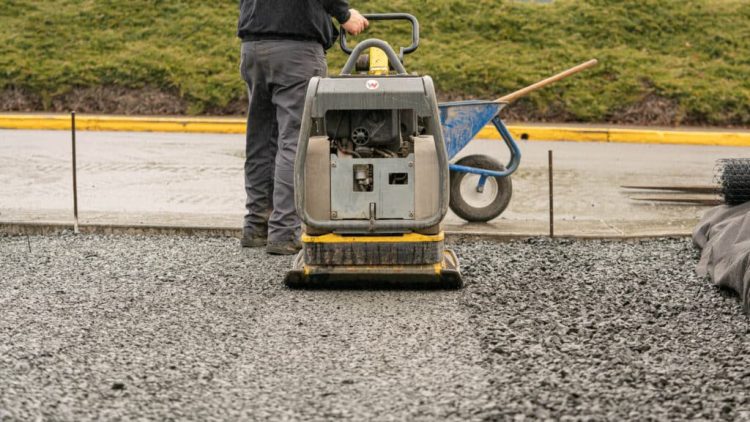
Notice we said “compacted.” This isn’t just about dumping gravel in a hole. The aggregate must be added in layers—called lifts—of no more than 2 to 4 inches at a time. Each lift gets thoroughly compacted with a plate compactor before the next layer goes down. Most plate compactors can only effectively compact about 4 inches of material, which is why adding it in thin layers is non-negotiable.
Here’s what happens when you try to compact 8 inches of gravel all at once: the top 4 inches get dense and solid, but the bottom 4 inches remain loose and uncompacted. Over time, that loose material settles under load, causing your pavers to sink and become uneven.
Proper compaction also requires the right moisture content. If the aggregate is bone dry, it won’t compact properly. A light misting with water helps the particles bind together and achieve maximum density. But too much water turns your base into a muddy mess that won’t support anything.
Layer 3: The Bedding Sand (The Final Leveling Touch)
Once your aggregate base is rock-solid and properly graded, you add a 1-inch layer of bedding sand. This isn’t beach sand or play sand—it’s coarse concrete sand or specialized bedding sand designed for paver applications.
The bedding sand serves several purposes. It provides a smooth, level surface for the pavers to sit on. It allows for minor adjustments during installation. And it creates a buffer that helps the pavers settle uniformly when they’re compacted into place.
This layer should be screeded perfectly level (or to your drainage slope) using rigid guides and a straight board. Professional installers use 1-inch metal conduit or pipes as screed rails, spreading sand between them and dragging a 2×4 across to create a perfectly consistent thickness.
Many contractors make the mistake of using stone dust or limestone screenings for the bedding layer. While these materials are easy to grade and level, they actually cause problems. Stone dust holds moisture, which can lead to efflorescence (white haze on pavers), create freeze-thaw issues in cooler climates, and even have pH levels that degrade the pavers over time.
Why Florida’s Soil Conditions Change the Rules
If you’ve researched brick paver installation online, you might have noticed something confusing: some Florida contractors claim you don’t need a gravel base at all. This isn’t a myth—it’s a regional reality based on soil conditions.
In many parts of Southwest Florida, including portions of Pasco County, the native sandy soil is so well-draining and stable that it can sometimes support pavers with just a compacted sand base. Some engineers have even signed off on paver installations with zero gravel base in developments with excellent native soil.
However—and this is crucial—this approach only works in specific conditions: established neighborhoods with naturally compacted sandy soil, pedestrian-only applications, and areas where the native soil has been undisturbed for years.
For driveways, newly developed areas, locations with clay content, or anywhere the soil has been recently filled or graded, a proper aggregate base is absolutely necessary. No exceptions.
The problem is that some contractors use “Florida’s sandy soil” as an excuse to cut corners on every project, regardless of whether conditions actually support that approach. They pocket the savings from skipped materials and labor, while homeowners end up with failing installations.
At Hilimire Pavers, we never gamble with your investment. Every project gets a proper multi-layer base engineered for long-term performance, regardless of soil conditions. It’s the only way to guarantee results that last.
The Compaction Process: Where Experience Shows
Installing a proper base isn’t just about using the right materials in the right thicknesses. The compaction process itself requires skill, experience, and the right equipment.
A quality plate compactor needs to deliver at least 5,000 pounds of compaction force. Smaller units might be cheaper to rent, but they won’t achieve the density required for a stable base. This is especially true for driveways and high-traffic areas.
The compaction pattern matters too. Professional installers make multiple passes over each area, moving in different directions to ensure uniform density. They pay extra attention to edges, corners, and transitions where settling is most likely to occur.
Testing compaction is part of the process, even though most homeowners never see it happen. An experienced installer can often gauge proper compaction by sound, feel, and visual inspection. The base should be so firm that walking on it leaves no footprints. If you can sink into it, it’s not compacted enough.
The Critical Role of Drainage and Slope
Even a perfectly compacted base will fail if water can’t escape. Proper drainage planning is part of every professional brick paver installation, and it starts with the base.
The entire base system—subgrade, aggregate, and bedding sand—must be graded with a consistent slope away from structures. The standard is a 1% to 2% slope, which translates to about 1/4 inch of drop per linear foot. This might not sound like much, but it’s enough to move water away from your foundation and prevent pooling on the paver surface.
For larger projects or areas with challenging drainage, additional measures may be necessary. This could include perforated drain pipes in the aggregate base, catch basins, or connection to existing storm drainage systems.
Florida’s frequent heavy rains make drainage even more critical than in drier climates. A base that can’t shed water quickly will hold moisture, which can lead to:
- Settlement and sinking as water undermines the base
- Organic growth (algae, moss, mildew) on paver surfaces
- Deterioration of bedding sand and joint sand
- In rare cold snaps, potential frost heave damage
The slope must also be consistent across the entire surface. Bellies or low spots that trap water will show up as stains, algae growth, or uneven wear on your pavers. A laser level or quality 4-foot level is essential for checking grade during installation.
Edge Restraints: The Unsung Hero of Base Stability
Here’s something most homeowners never consider: without proper edge restraints, even a perfect base will eventually fail. The pavers at the perimeter are subject to lateral forces—people stepping on edges, vehicles pulling into driveways, soil movement from adjacent landscaping.
Edge restraints lock the entire paver field in place, preventing the edges from spreading outward and the whole system from shifting. These can be commercial plastic or aluminum edging systems, concrete curbs, or in some cases, soldier courses of pavers set in concrete.
The edge restraint is installed after the base is complete but before pavers are laid. It’s anchored with spikes driven through the restraint and into the compacted base. This creates a rigid perimeter that holds everything in place.
Skipping or cheating on edge restraints is one of the most common shortcuts we see when repairing other contractors’ work. It might save an hour of labor and fifty bucks in materials, but it guarantees the installation will fail.
The Polymeric Sand Misconception
Many homeowners have heard about polymeric sand and assume it somehow makes up for a weak base. It doesn’t.
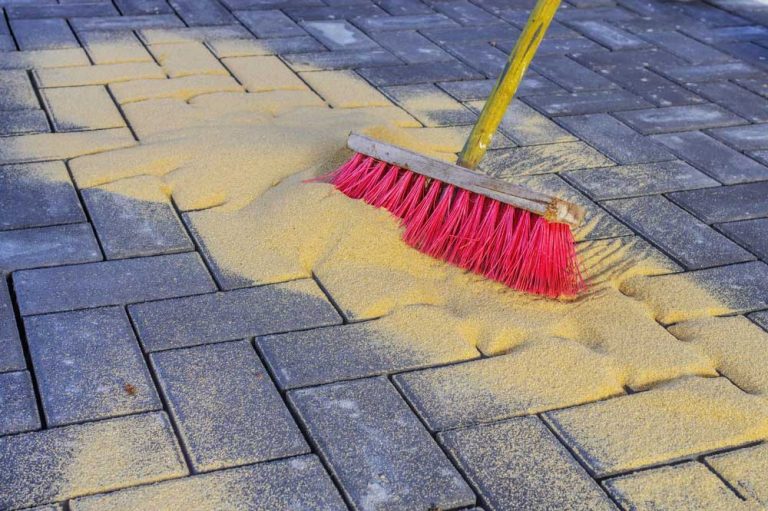
Polymeric sand goes between the pavers after installation—in the joints—where it hardens to lock pavers together and prevent weed growth. It’s an excellent product for joint stabilization, but it does nothing to address base problems.
If your base is inadequate, polymeric sand in the joints will crack and fail right along with the pavers as they sink and shift. No jointing material can compensate for poor foundation work.
That said, polymeric sand does play a role in overall system stability. When combined with a proper base, it helps achieve vertical interlock between pavers, preventing them from rocking or rotating under load. But again—this only works when the base beneath is solid.
What Happens When Contractors Cut Corners
We see the results of substandard installation regularly when homeowners call us for restoration work. Here are the most common base-related failures:
Uniform Sinking: The entire paved surface has settled 1 to 3 inches below its original height, creating trip hazards at transitions and poor drainage. This happens when the base wasn’t compacted properly or was too thin for the application.
Differential Settlement: Parts of the surface are lower than others, creating waves, dips, or uneven areas. This indicates poor compaction, inconsistent base depth, or subgrade problems that weren’t addressed.
Edge Failure: Pavers along the perimeter have shifted, separated, or collapsed. Almost always caused by missing or inadequate edge restraints combined with a base that extends beyond the paved area.
Bird-Baths: Low spots that collect water and won’t dry. These result from improper grading during base installation or subsequent settling in areas that weren’t fully compacted.
Complete Structural Failure: Severe sinking, widespread cracking, and large separations between pavers. Usually seen in driveways where a pedestrian-rated base was used for a vehicular application.
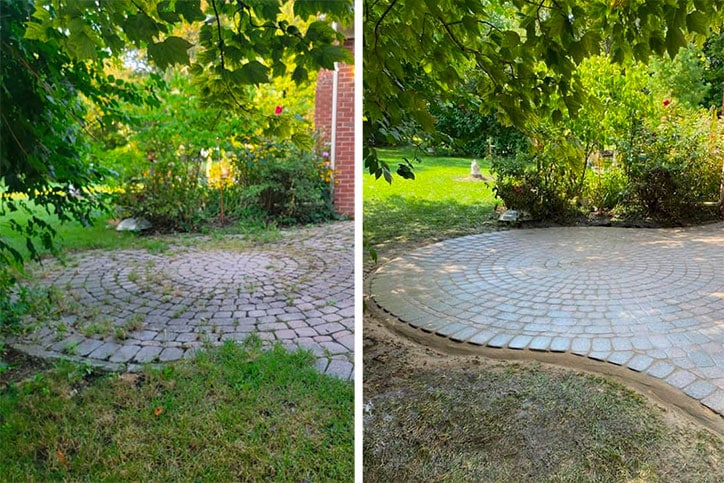
In many cases, these failures can’t be fixed with simple repairs. The pavers have to be removed, the base has to be excavated and rebuilt properly, and then new or cleaned pavers get reinstalled. It’s essentially doing the job twice—at several times the original cost.
Why Professional Installation Matters
Could a motivated homeowner with the right equipment install their own paver base? Technically, yes. But here’s what separates a professional installation from a DIY attempt:
Site Assessment: Experienced installers understand how to read soil conditions, recognize drainage challenges, and identify potential problems before they become failures. We know when to add geotextile fabric, when to increase base depth, and how to handle transitions between different surface types.
Proper Equipment: Professional-grade plate compactors, screeding tools, laser levels, and other specialized equipment aren’t just expensive to rent—they require skill to use effectively. Improper technique with proper equipment still produces poor results.
Material Knowledge: Not all crushed stone is the same. Not all sand is suitable for paver bedding. Professionals know which materials work in Florida’s climate and soil conditions, and which suppliers provide consistent, quality products.
Efficiency and Quality: A skilled crew can excavate, grade, compact, and prepare a base in a fraction of the time it takes an inexperienced DIYer. More importantly, they get it right the first time, avoiding the costly do-overs that often plague self-installed projects.
Warranty and Accountability: When a professional installer stands behind their work, you have recourse if problems develop. DIY installations have no such protection.
The Hidden Cost of Cheap Installation
The quote from the contractor who charges 40% less than everyone else might seem appealing, but consider what they’re cutting to hit that price:
They’re using less base material or no base at all. They’re skipping compaction steps or using inadequate equipment. They’re eliminating edge restraints or using substandard materials. They’re rushing through the grading and preparation to keep labor costs down.
In other words, they’re building a beautiful-looking surface on a foundation destined to fail.
The true cost of cheap installation becomes apparent two or three years later when you’re facing repairs that cost more than doing it right would have in the first place. Plus, you’ve lost years of enjoyment from your outdoor space and dealt with the frustration of a deteriorating surface.
Professional brick paver installation costs more upfront because it includes everything necessary for long-term performance: proper excavation, quality materials in adequate quantities, thorough compaction, correct drainage grading, and attention to details that make the difference between success and failure.
Base Installation in Florida’s Climate
Florida’s unique climate adds another dimension to base requirements. Our heat, humidity, frequent rain, and sandy soils create conditions that are both advantageous and challenging.
Advantages:
- No freeze-thaw cycles that plague northern installations
- Sandy native soil in many areas provides excellent drainage
- Established ground that’s naturally compacted from years of exposure
Challenges:
- Heavy, frequent rainfall that can undermine poorly drained bases
- High water tables in some areas requiring special drainage considerations
- Hurricane-force winds that can shift poorly restrained installations
- Heat and humidity that accelerate organic growth if drainage is poor
A properly designed base addresses these challenges while taking advantage of Florida’s natural benefits. The result is an installation that weathers tropical storms, sheds daily thunderstorm rain, and maintains its integrity through decades of heat and humidity.
Questions to Ask Your Contractor
When evaluating proposals for brick paver installation, these questions will reveal whether a contractor understands proper base preparation:
- What’s the depth of excavation for my specific soil conditions and project type?
- What type of aggregate will be used, and what’s the gradation?
- How will the base be compacted, and what equipment will you use?
- What’s the plan for drainage and slope?
- What edge restraint system will be installed?
- Will geotextile fabric be used, and under what conditions?
- How do you ensure consistent base depth and proper grading?
Contractors who give vague answers or seem annoyed by technical questions are waving red flags. Professionals welcome these discussions because they’re confident in their methods.
Be especially wary of anyone who dismisses base importance with phrases like “we’ve been doing it this way for years” or “that’s overkill for this project.” Proper base preparation isn’t optional or negotiable—it’s the foundation of quality work.
The Hilimire Pavers Difference
At Hilimire Pavers, we never use subcontractors. Lloyd Hilimire and our trained in-house team handle every aspect of installation, from excavation to final compaction. This means quality control at every step, with experienced eyes on the base preparation that determines your project’s success.
We don’t require deposits because we’re confident in delivering results worth paying for. We’re on-site during installation to ensure every layer meets our standards. And we’ve built our reputation over 16 years by doing the work that others skip—the unseen foundation work that separates installations that last from those that fail.
When we tell you about proper base preparation, we’re not trying to upsell you on unnecessary work. We’re explaining the engineering reality of how paver systems function and why shortcuts inevitably lead to failure.
Your outdoor space is an investment. The pavers you can see might be the pretty part, but it’s the base you can’t see that determines whether that investment appreciates or depreciates over time.
The Bottom Line
The base makes or breaks your pavers. Not the paver color, not the pattern, not the sealing or joint sand. Those things matter, but they’re cosmetic compared to the foundational importance of what’s underneath.
Proper brick paver installation requires proper base preparation: adequate excavation depth for your soil and use case, quality aggregate materials in sufficient quantities, systematic compaction in appropriate lifts, correct drainage grading, professional edge restraint systems, and attention to details that separate lasting quality from future failures.
Cutting corners on the base isn’t saving money—it’s buying yourself expensive problems in the near future. The contractors who charge the least aren’t doing you any favors. They’re building beautiful failures.
Invest in the base. Invest in professional installation. Invest in contractors who understand that what you can’t see matters more than what you can.
Because when it comes to brick paver installation, the truth is simple: the base makes or breaks everything.
Ready for a paver installation built to last? Explore our brick paver installation services for driveways, patios, pool decks, and walkways throughout New Port Richey and Pasco County. Or call us at (727) 457-9419 for a free, no-pressure consultation where we’ll explain exactly what your project needs—including the proper base preparation that ensures decades of performance.